
Move Better. Feel Better. Get Back To doing What You Love.
Targeted remedial therapy and personalised back pain rehabilitation in Kangaroo Point, Brisbane.
Whether you're looking for hands-on treatment or a plan to address reoccurring back pain, we'll help you find the right starting point and support you to build lasting strength.
$100, credited to your plan. No lock-in. Kangaroo Point location or online.
★★★★★ 150+ Google reviews · 16 years · Trusted by the Broncos




Trained in the NeuroHAB Method by neurosurgeon Dr David Johnson · Trained under McGill, Levels 1, 2, 3
Private health rebates available.
Worried movement will make it worse?
You're not meant to work this out alone.
That fear is fair, and it's the thing that keeps most people stuck. You won't be handed a printout and left to it. You get a plan built for you, and a person who keeps it on track.
✔ Guidance
We show you exactly what's safe to load, and what to avoid, for now.
✔ Support
Someone in your corner as you go, so you're never guessing on your own.
✔ Advice
When it flares, or life gets in the way, you ask and you get a straight answer.
Most people get treated where it hurts. We find what's actually causing it.
You back off, it settles. You load back up, it comes back. Somewhere in that loop is the real cause, and it's rarely where the pain shows up.
THE TRANSFORMATION
You don't just get out of pain. You get your life back.
Getting out of bed without your back being the first thought. Picking up your kid without bracing. Training again without fear. That's the real win: not just less pain, but a body you trust, and the life you'd stopped living.
Scared of your own body
Trusting it again, and managing it yourself
Bracing for the next flare-up
Stronger than before the pain, and it holds
Stopped doing what you love
Back doing it. Carrying your kids. Sleeping through the night.
Rewiring Movement · Reclaiming Life
HOW IT WORKS
We don't guess. We measure.
Most people have been treated. Very few have been measured.
We find what's actually causing your pain, rebuild it in four phases, and prove the change with real numbers, not a feeling.
The Pain to Strength Method · Four Phases
-
Repair
Settle what keeps flaring
Calm the flare, find the movements you tolerate, stop bracing.
-
Restore
Rebuild what failed
Rebuild strength and control in the pattern that let you down.
-
Resilience
Make it hold
Load goes up, life comes back, sleep, food and stress handled.
-
Performance
Stronger than before
More capable than before the pain. The point, not the bonus.
MEASURED, NOT GUESSED
In Brisbane, AxIT force-plate testing shows exactly how much force each side of your body can produce. Working online, we retest through movement and strength. Either way, you see the change on a screen, not just on a good day. Retested every 7 weeks.
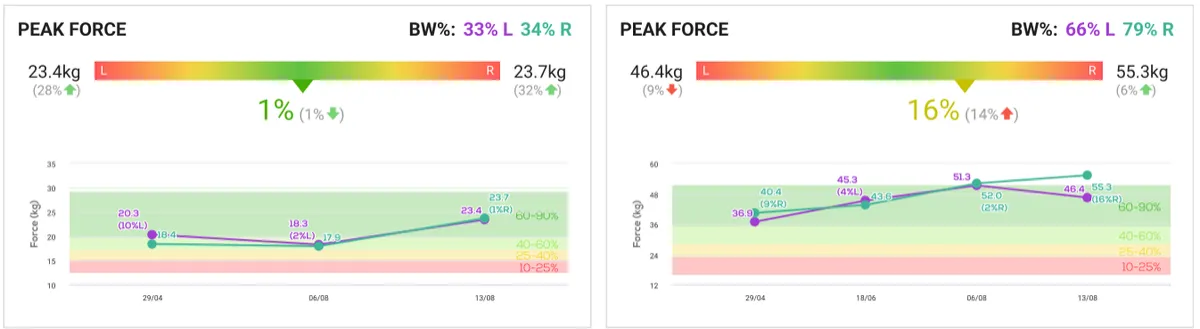
A real client's force plates, anonymised. Left versus right, measured every retest. This one's knee-extension force climbed from 37kg to 55kg across successive retests. Numbers, not a feeling.
A back like this takes time to settle, and it can't be rushed. That's why the first phase is a 14-week initial commitment. It's the shortest honest window to calm the system down, rebuild the pattern that failed, and prove the change with real data. It isn't a package you're buying. It's how long the work actually takes, and anything shorter is what you've already tried.
It doesn't stop when you're strong. It continues into ongoing care, so the pain doesn't come back and run your life again.
Rewiring Movement · Reclaiming Life
Real numbers. Real people.
You don't have to take our word for it.
Jo's Story
One nasty fall from horse riding. One fractured spine. 18 months without a full night's sleep. 12 months with Neura and she trains 4 days a week, joined a gym on her own, and carries her daughter on her shoulders again.
Tim's Story
One nasty bouldering accident. 2 surgeries. 3 years of ongoing back pain. 12 months with Neura. Now climbing V9 again, his equal-hardest grade ever, and his first since 2019, before his accident.
Dee's Story
Told she would never move again. One surgery. Two hospital stays. Years of opioids and dead ends. Six months with Neura. 60kg deadlift, 50kg squat, and she dresses herself every morning.
Gifford's Story
Couldn't garden or walk with his wife. Walked through Patagonia, pain-free.
★★★★★ 150+ Google reviews · 16 years · Trusted by the Broncos
Rewiring Movement · Reclaiming Life
Watch 60 seconds with Matt
Meet the Founder
I don't accept “learn to live with it.”
I watched a system that didn't have time fail my mum. Then it happened to my own back. A few tests, a script, and good luck. So I built the opposite.
What follows isn't another rehab routine. It's the system that's helped 2,500+ people trust their body again.
16 years · Trained in the NeuroHAB Method by Dr David Johnson · Trained under McGill, Levels 1, 2, 3 · Trusted by the Broncos
Matt Kaloutsis, Founder
the assessment
Find out what's actually causing your back pain.
One session. $100.
One honest hour. A clear answer on what's wrong and what to do next.
what you get
A 60-minute Movement & Strength Assessment, at Kangaroo Point or online
Testing that shows how your body handles load: force plate in person, full movement screen online
A written report within 48 hours: the cause, and the plan to fix it
Yours to keep, whether you continue with me or not
No clear answer? Full refund.
Then I tell you the right level of care. Might be one session. Might be a rehab phase. Might be nothing.
And if your retest says you don't need me anymore, I'll tell you.
Most clinics are built to keep you. This one's built to let you go.
16 years. 150+ Google reviews. Trained under Dr Stuart McGill (Levels 1, 2 and 3) and in the NeuroHAB Method by neurosurgeon Dr David Johnson.
Rewiring Movement · Reclaiming Life
Questions, answered honestly.
This is for you if you've had back pain for three months or more, you're done with temporary fixes, and you'll do the work. It's not for you if you want a passive quick fix with no effort on your side. That's fair. It's just not what this is.
How much does it cost?
The assessment is $100, credited toward your plan if you continue. Ongoing care is prescribed after the assessment, once we know what you actually need, and there's no lock-in. Private health rebates are available.
My physio didn't work. Why would this be different?
Physio often stops the moment the acute pain settles. We keep going until the pattern and the strength underneath it are rebuilt, and we prove it with numbers, not a feeling.
Will my back pain ever go away? Is it permanent?
For most back pain, no, it isn't permanent. Real pain doesn't mean a permanently broken body. A system that has lost control can be retrained.
Can rehab help me avoid back surgery?
Sometimes yes, sometimes no. It depends on what your scan shows and what your movement assessment reveals. Most chronic back pain isn't actually structural, even when a scan looks ugly.
Discs and joint changes show up on the imaging of pain-free people all the time. The deciding factor is usually whether your nervous system has lost control of the stabilising muscles around your spine, and that's exactly what we assess.
If rehab is likely to work for you, I'll tell you. If surgery is genuinely the right call, I'll tell you that too. The framework draws on the work of a neurosurgeon (Dr David Johnson, NeuroHab Method) and the world's leading low back researcher (Professor Stuart McGill) for a reason.
Are you a physio?
No. Remedial therapist and exercise rehab specialist, 16 years, working in the gap between physio and personal training.
Can I claim on private health or Medicare?
Private health, yes, depending on your cover. Not through Medicare.
I'm not in Brisbane. Can we still work together?
Yes. The online program is structurally identical to in person.
Stop managing your back.
Start rebuilding it.
One assessment. Real numbers.
An honest answer on whether I can help, and what comes next.
Rewiring Movement · Reclaiming Life
ABOUT US
Neura Rehab and Performance currently services a broad area surrounding the South and East suburbs of Brisbane.
Start your journey to a back pain free life with founder, Matthew Kaloutsis.
CONTACT US
HELPFUL LINKS



© Copyright 2026. Neura Rehab & Performance. All Rights Reserved.